

Foot Problems Can Cause Back Pain!
Back pain can be caused by a number of things from injury to stress to poor posture. The difficulty lies in diagnosing the proper cause and attempting to rectify the situation. Did you know a misalignment of your body no matter how small, can wreak havoc from your head to your toes?
Pain is a sign that something is wrong, and should never be ignored! A complete evaluation from your physician is always recommended to rule out any significant problems. Still plagued with back pain after a clean bill of health? Take a look at your feet! Ask yourself these questions –
- Does one side of your shoe wear out before the other?
- Are your toes crooked?
- Do your feet point in or out excessively when you walk?
- Do you suffer from heel pain, knee pain or shin pain in addition to your back pain?
- Do you frequently sprain your ankle?
- Do your feet hurt in general?
If you answered yes to any of these questions, perhaps it’s time to look more closely at your feet!
The main function of your feet is to act as shock absorbers as you shift your weight with each step you take. Structural problems, such as your feet rolling inward, called over-pronation, can cause problems all the way up to your back!
The rolling of your foot inwards causes the arch to flatten and collapse under the body’s weight. This continued stress could cause deformities of the foot over time, such as misaligned bones, hammertoes, bunions, knee pain and back pain.
With the inward rolling of the foot, the lower leg begins to rotate internally. This rotation may cause the pelvis to tilt forward, thus increasing the curve of the low back and potentially throwing off your leg length, temporarily. Excessive curvature can create tightness of the anterior hip muscles, weakness of the hips and gluts aswell as stiffness in the low back resulting in pain!
Hip Exercises!
…..Hip Exercises?…….How can hip exercises help back problems stemming from your feet?When your hips get weak, there tends to be more stress rotating the upper and lower leg which increases stress along the bottom of the foot to compensate. Try these hip exercises to reduce both your foot and back pain.
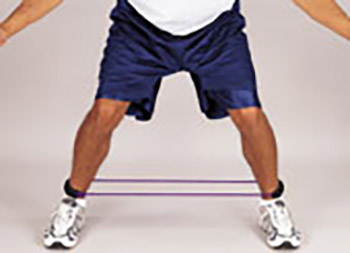
Monster Walks: Walk sideways with rubber therapy band around your ankles so that the band is kept tight as you walk. Repeat this to fatigue in each direction x 3. You should feel this in the side of your butt cheeks.
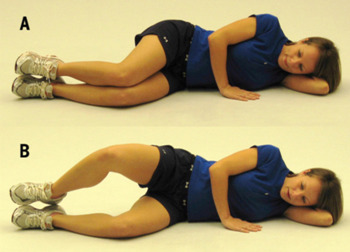
Clamshells: Lie on your side with your knees bent up to a 45 degree angle. Raise the top knee, keeping it bent, until your knee is pointing up to the ceiling. Repeat this on both side 3×15 or until the muscles fatigue. If this is too easy, you can also place the rubber therapy band around your knees for added resistance.
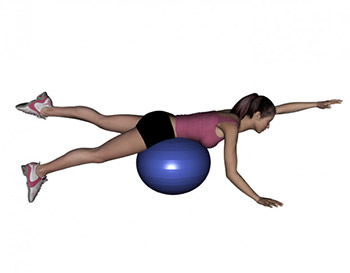
The Swimmer: Lie over the therapy ball on your stomach, fully extend one leg and the opposite arm up towards the ceiling (slowly to maintain your balance). The foot should be rotating outwards as you lift your leg so that you are engaging your hip and gluteus muscles at the same time. Repeat this 3 x 15 or until fatigue of the muscles.
What To Expect
Typically, it takes about 10,000 repetitions to FULLY re-educate a muscle (I know!) It sounds like a lot but, if you’re consistent with these on a daily basis, you should start to see changes to your pain within the first 1-2 weeks and fully re-educate the muscle within 6-8 weeks.
When in doubt or if the exercises are causing or increasing your pain, always obtain advice from a qualified medical professional before attempting to correct foot issues with orthotics or continuing on with the exercises. Consider that there will be some muscle soreness associated with new exercises for 1-2 days after the exercise but this should not be the same as “your” pain and should be dissipate as your body gets used to doing them.
For other information or clarification on this blog, please contact Danielle Vernon, Physical Therapist at danielle@backbonecushion.com.