

Do you suffer from back pain?
If so, you’re not alone. In fact, around 80 percent of adults over the age of 35 have had some sort of back pain and 16 percent of American adults experience persistent or chronic back pain that limits their daily activities. Luckily, with the right lumbar support, you can minimize your back pain.
But, what is lumbar support? And, how can it help you? Check out this guide to learn everything you need to know about lumbar support and how it can save your back.
What is Lumbar Support?
Lumbar support refers to any type of support you provide to your lower back.
This includes support given by mattresses, office chairs, and belts. The lumbar region is made up of five vertebrae that sit between the diaphragm and the sacrum.
Injuries to your lumbar region can have a negative impact on your muscles, nerves, discs, and vertebrae. Luckily, with the right lumbar support, you can protect this vital area of your body.

Why is Lumbar Support Important?
Sitting for long periods of time can be extremely taxing on your lower back. Without the right back support, there’s added stress on your lumbosacral discs.
This can lead to poor posture and distressed joints. If you spend a lot of your day sitting in an office chair without the correct lumbar support, then you’re even more susceptible to experiencing stress in your lower back. Even if you don’t spend your day sitting in an office chair, many of us tend to form poor posture in other ways- when sitting at the computer, sitting in front of the TV, or when sitting in a classroom.
When you slouch and use incorrect posture, the lower part of your back pushes out and the natural inward curve of your spine goes in the opposite direction it’s supposed to. This can cause the pain in your back to get worse and worse.
Wait! Did you know Thoracic support is also important?
When someone says thoracic, most people say “thora-what”? Despite the fact that these valuable 12 vertebrae are the anchors to our ribs, protect our vital organs and keep our body upright and stable, they are very rarely talked about. True, they are rarely the proverbial “squeaky wheel” so they get ignored. But, did you know that, the thoracic is arguably more important to support than the lumbar because it can control what happens above (the neck) and below it (the lumbar)?
Think about how you grab a glass of water: Would you grab it from the very bottom or the very top? Of course not because this would probably (especially if you’re me) lead to a very wet floor. Our best control comes from grabbing that glass by the middle. So why don’t we support our spine in this way? (segue back to the squeaky wheel analogy).
Yes, the lumbar talks to us more but what if I told you the lumbar could be protected if only we would care more for that thoracic region. Taking care of those heavy 12 vertebrae of our mid-back allows elongation of our spine and takes the pressure off our lower back. In addition, with less pressure, our lumbar is allowed to be naturally guided back into its normal lordosis. Plus, if our mid-back is supported, our head naturally gets pulled back over the shoulders. Just imagine how good your body would feel if it was so easily aligned by just taking care of this middle area.
So, when you’re thinking lumbar support (which is obviously also valuable), don’t forget to take care of that red-headed step-child of the spine, your Thoracic. You’ll wonder why you didn’t do it sooner!
The Top Lumbar Support Tips
Luckily, there are a lot of things you can do to support your lumbar region.
1. Invest in the Right Office Chair
Did you know that Americans are spending more time sitting than at any other time in history? In fact, the amount of time we spend sitting has increased by 83% since 1950.
If you work a desk job, there’s only so much you can do about the number of hours you spend sitting each day. While you can walk around during your breaks and get up every so often to stretch out, a lot of the time, you need to just hunker down at your desk and work.
But, just because you can’t decrease the amount of time you spend sitting, doesn’t mean you can’t change how you sit. One thing that can have a very big impact on how you sit in your office chair.
When shopping for an office chair, you’ll want to look for one that’s ergonomically designed. When something is ergonomically designed, it means it’s optimized for your health and comfort in the workplace. Here are some things you’ll want to look at when choosing an ergonomic office chair:
Seat Height
You want your office chair to be easily adjustable. We recommend going for a chair with a pneumatic lever, as these are the easiest to adjust. Typically, a seat height ranging from 16 to 21 inches is best for most people. This will allow you to have your feet flat on the floor, your hips slightly higher than your knees and your elbows and forearms even with the height of the desk.
Seat Depth and Width
Typically, a seat width of 17 to 20 inches works for most people. The depth needs to be deep enough for you to be able to sit with your back against the chair while leaving about 2 to 4 inches of room between the back of your knees and the chair’s seat. Looking for a seat pan that adjusts between lengths is ideal so that you can set your chair at the length that works for you.
The forward and backward tilt of the chair should also be adjustable so that you can have the front of the seat slightly lower than the back for optimal pelvic position.
Seat Material
The seat material should have enough padding so you can comfortably sit for long periods of time. Popular seat materials include vinyl, leather, fabric, and mesh. Keep in mind that slicker surfaces like leather and vinyl may look more comfortable but will be harder to stay in the right posture without sliding around. Mesh may give way over time and fabrics tend to build smells and fur over time. There are going to be advantages and disadvantages to each type so pick the one that works best for you.
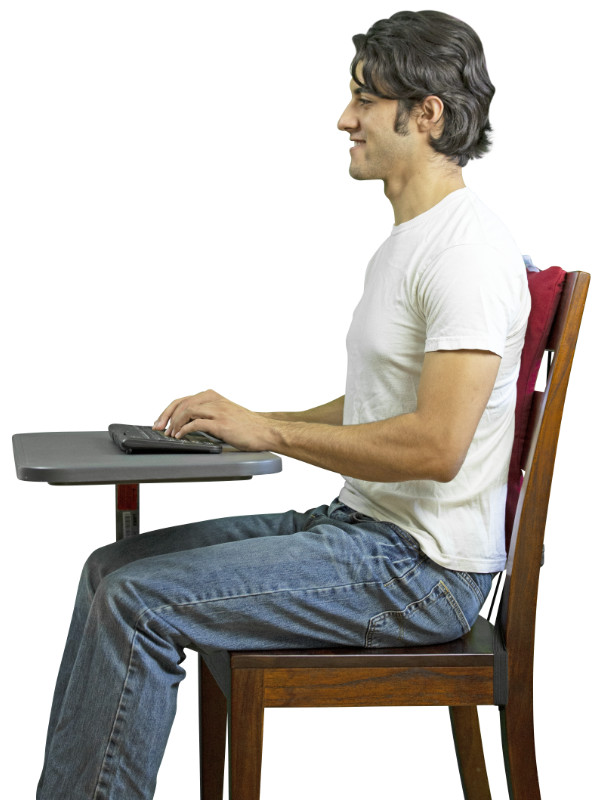
You also want to make sure that you’re seated in your chair the right way. Here’s how to sit for maximum support:
- Your elbows should rest comfortably on the arm supports at a right angle, arms working by your sides and minimize leaning forward on your desk
- Your knees should be bent at a right angle
- If there’s a footrest, you can use that to elevate your feet
- Your eyes should be looking straight ahead at the computer, chin slightly tucked but not bent down or lifting your chin up
- You should be able to comfortably lean back against the back support which will improve your sitting endurance and alignment
Check in with yourself throughout the day to ensure you’re sitting correctly.
2. Invest in a Lumbar Support Pillow
In addition to investing in an ergonomic office chair, it’s also a good idea to invest in a lumbar support pillow. These are sometimes referred to as lumbar pillows, back support pillows, or backbone cushions.
A lumbar support pillow should be placed between your lower back and your chair. In the case of backbone cushions, the support extends to your upper back for maximum effectiveness. This type of pillow is specifically designed to ease the stress of sitting at a desk all day. Here are some of the benefits of a lumbar support pillow:
Support for Your Backbone
Back support pillows are very flexible and can easily conform to your body’s shape. If you suffer from a collapsed spine, this can be particularly helpful.
All you need to do is slip the pillow behind your back, and you’ll immediately feel the impact.
Relax Your Tired Muscles
As we mentioned earlier, the more time we spend sitting, the more prone we are to slouching. This, in turn, increases the amount of strain we put on our backs.
With a lumbar support pillow, you can straighten your posture and take some of the load off your back.
Provides Quick Pain Relief
Another great thing about a lumbar support pillow is that it can provide quick pain relief to your lower back. When your back muscles become fatigued and that fatigue is left untreated, it will transform into a shooting pain.
This can eventually lead to chronic back pain and spinal disorders. A lumbar support pillow is one of the best ways to prevent this type of pain from forming. Not only can this pillow relieve pain in your lower back, but because the backbone cushion extends into your upper back, it can also relieve pain in your neck and shoulders.
It's Portable, Versatile, and Cost-Effective
You can’t take your ergonomic office chair with you wherever you go, but you can take your lumbar support pillow with you wherever you go. Plus, lumbar support pillows aren’t just for office chairs.
You can bring your support pillow with you for long flights and long drives. You can use it when you’re working from home or working from a coffee shop. It can even provide you with relief when you’re watching TV or working in the kitchen.
And, best of all, lumbar support pillows are very cost-effective. You can easily find these pillows for under $100.
3. Invest in the Right Mattress
While you spend a lot of time sitting at the office, you also spend a lot of time sleeping. For this reason, you also need the right mattress for lumbar support.
When choosing a mattress for lower back pain, you’ll first want to think about the firmness. Generally speaking, you’ll want to err on the side of firm. If your mattress is too soft, your body will sync into it. This will cause your spine to bow unnaturally.
We recommend that you always test a mattress out before buying, as the firmness level can truly make all of the difference. Also, keep in mind that if you have a partner who’s significantly larger or smaller than you, you’re both going to require different levels of firmness.
When it comes to the material, we recommend going with a memory foam or latex mattress.
In addition to the mattress, you’ll also want to make sure you choose the right pillows, as these can also make a huge difference when it comes to lumbar support. When buying pillows, you’ll want to consider your sleep position. Here’s what to keep in mind:
- Side Sleepers: As a side sleeper, you’ll want to use a thicker pillow, as this will help you keep your neck and head in a neutral position
- Back Sleepers: For back sleepers, it’s a good idea to invest in a small pillow to place between your knees, as this will help relieve the pressure from your sciatic nerve and spine
- Stomach Sleepers: If you’re sleeping on your stomach, you should actually try to train yourself to sleep in a different position, as stomach sleeping is very bad for your back
As you’re adjusting to your new sleeping position as a stomach sleeper, you can place a pillow under your stomach in the meantime to take some of the pressure off of your lower back.
4. Do the Right Stretches and Exercises for Your Back
Performing exercises and stretches that target your back muscles can help minimize chronic pain and support your lumbar region. Here are some exercises and stretches you can do for lumbar support:
Child's Pose
The child’s pose is a traditional yoga pose that works your glutes, spinal extensors, and hamstrings. It’s also a relaxing stretch that promotes flexibility and blood circulation.
To perform this stretch, place your hands and knees on the ground and sink your body back through your hips until your bottom rests on your heels and your belly rests on your thighs. Then, extend your arms in front of you with your palms facing up.
Breathe deeply and hold the stretch for one minute.
Knee to Chest
Another great stretch for lumbar support is the knee to chest stretch. For this move, you’re going to need to lie on your back with your feet flat on the floor.
Then, draw one of your knees toward your chest and clasp your hands to your thighs for support. Make sure to lengthen your spine through your tailbone, as this will prevent your hips from lifting off the floor. You can hold the pose for one to three minutes before switching to the other side.
Seated Spinal Twist
This stretch isn’t just great for your back, it’s also great for your glutes, hips, abs, shoulders, and neck.
To perform this stretch, sit on the floor with both legs stretched out in front of you. Then, bend your right leg and lift it to the outside of your left thigh.
Then, place your left arm on the outside of your right leg for support as you twist to the right. You can hold this stretch for one minute before switching to the other side.
Bridge
The bridge pose helps to work your glutes and your hips in addition to strengthening your lower back. To perform this exercise, lie on your back with your knees bent.
Then, press your feet into the floor as you raise your buttocks off the ground. Keep your arms at your sides and squeeze your butt on the way up. Lower your butt slowly to the ground and repeat 10 to 15 times.
Lying Lateral Leg Lift
This move works your hip abductor muscles in addition to your lower back. To perform this exercise, lie on one side with your legs pressed together.
Then, raise your top leg a couple of feet, making sure to keep it straight and extended. Hold your leg at the top for a couple of seconds before lowering it back down. You can even do mini pulses at the top for an extra burn.
Repeat this around 10 to 15 times on one leg before switching to the other one.
Are You Ready to Give Yourself Better Lumbar Support?
Now that we’ve answered the question, “What is lumbar support?”, you should have a better idea of what you need to do to support your lumbar region. Before you know it, you’ll be sitting and sleeping more comfortably and your back pain will be subsiding.
If you’re looking to buy a back support pillow to help with your lumbar region, be sure to check out our selection today.
Hello…
The blogs are really appreciable and one can trust the knowledge and information provided in the writing.
Would you be concerned about exchanging hyperlinks?